Monday, January 9, 2012

Answer for Mrs. Radner's Fourth Grade Class

Mrs. Radner's Fourth Grade Class asked:
Dear Dr. Sokol:
We are exploring the "Westward, Ho!" movement and learning about travel in a wagon. We discussed the items we would bring if we were travelling out West. We saw that you travel by helicopter and that you said you put a lot of gear in that helicopter. We were wondering if the kind of gear you put into your helicopter is similar to what we would put in a wagon to travel out West.
The answer to this question depends on whether I am heading out to the field just for the day, or if I am heading out to a field camp for many days and nights.  When we have a lot of work to do in the Dry Valley desert, we will camp near the work site because it will take us more than one day to complete our tasks.  When I went out to Lake Fryxell Camp I had to pack food, clothes, a tent, a sleeping bag and sleeping mat, some tools, hiking boots, and lots of socks.  I bet this list is similar to what people had in their wagons when they were traveling west.  However, I also took science gear with me.  This included whirl packs (which are plastic bags for collecting samples), instruments to measure the amount of water in the soil, flags for marking plots where we sample, test tubes, and a special liquid chemical for preserving the DNA in soil (so we can study it later).  I suspect that these items would not be found in the wagons in the "Westward, Ho!" movement.  I've included some pictures, below, of other things that we brought out to the field with us...

An instrument that measures the amount of carbon dioxide coming out of the soil.

Stabilizers - these strap on to my hiking boots and give me traction on the ice, so I can walk across frozen lakes and glaciers.

Here I am with my water bottle.  It's as important to have something to carry water in so I don't get dehydrated.

Here is Adam next to a stream on top of a glacier (Canada Glacier).  We stopped to get some water from this stream.  

On the left is a hand held GPS (global positioning system) - this tells us where we are.  We use this to record the location of all of the places from which we collect samples.

Here is Adam sampling some soil near Canada Glacier.  

Friday, January 6, 2012

Back from the field camp

I just got back from a week in the Dry Valleys, specifically Taylor Valley. Between work and internet outages at the camps, I wasn't able to update the blog, but now I'm back in McMurdo so expect some more updates and pictures.

My tent at the camp at Lake Bonney in Taylor Valley
I had lots of different tasks while I was in Taylor Valley.  This year I am working on projects that are part of the McMurdo Dry Valleys Long Term Ecological Research Program.  Lots of scientists have been working on this research for a long time so that we can understand how the ecosystem works in Antarctica.  I'm working with the soil scientists so I got to do lots of hiking to collect soil samples to bring back to the lab.  I also had to use a machine to measure the amount of carbon dioxide coming out of the soil, which we can use to figure out how active the soil microorganisms are.

I had a chance to hike over the Canada Glacier, and hike up to the Hughes and Taylor Glaciers.  The Glaciers are very impressive up close.
The Hughes Glacier

Expect more blog posts and pictures and answers to questions in the coming days.   Oh, and Happy New Year!

Angelica asked:
Which part of Antarctica do the penguins live in? Also, have you seen any big groups of penguins?
That's a great question!  The penguins live in rookeries.  Rookeries are the places where the penguins build their nests, and they are near the coast of Antarctica.  However, there are places in Antarctica where the ice over the sea never melts (this is called the ice shelf), so they have to be far enough north so that they can find places where the ice melts or cracks so they can get into the water to find food.  

The place where I am is McMurdo Station, which is on Ross Island, which is partially surrounded by ice shelf (does not melt) and sea ice (does melt).  Because we are near ice that melts, we have penguin colonies on this island, but I haven't been able to see them because they are on a part of the island that you can only go to if you have a special permit.  I have heard that when the ice melts near McMurdo Station later in the year that we will see more penguins and whales.  I hope that happens before I have to leave.

Monday, December 19, 2011

Check out the nemablog (http://nemablog.wordpress.com/)!  This is a blog by some of my colleagues from Colorado State who study nematodes, and work with us down here in the Dry Valleys.

Saturday, December 17, 2011

Field work in the Dry Valleys, Antarctica

Our team of scientists setting up a plot for sampling soil at a pond in the Dry Valleys
We finally made it out to our field site to start setting up our research.  We camped in Taylor Valley (a Dry Valley) for 2 nights while we were doing our work.  The picture above shows the team of scientists I work with.  One of the major goals of our work is to understand the biology of Antarctic soils.  The point of the experiment we are setting up in the picture is to understand how life in the soils will respond to climate change.

The Dry Valleys are one of the few places in Antarctica where the land is not covered by ice.  The types of animals we find in the Dry Valleys are very small organisms that live in the soil.  You need a microscope to see most of them, and they include round worms (nematodes), spring tails (collembola), water bears (tardigrades), rotifers, and mites.  We also study the bacteria that live in the soils.

In our experiment, we will add water from the pond that you see in the picture above to large plots of soil.  We are doing this because we expect more ice will melt in Antarctica in the coming years, and we want to know what this added water will do to the animals and the soils.

Thursday, December 8, 2011

Travel to McMurdo

I suppose I'm telling you the story about my journey out of chronological order this year.  I wrote about getting warm clothes in New Zealand below, but here's how my trip began.

I left Blacksburg, Virginia (where Virginia Tech is located) at 1:30 pm on December 1, eastern standard time (EST).  Michigan and Virginia are both in the eastern time zone.  I first had a 45 minute car ride from Blacksburg to the airport in Roanoke.  I then took an airplane from Roanoke to Charlotte, North Carolina and got on another plane to fly across the country to Los Angeles, California.  I got on a plane in LA at 11 pm on December 1 in the pacific time zone, and 14 hours later I landed in Aukland, New Zealand at 10 am on December 3.  The time in New Zealand is 18 hours ahead of EST.  That means if it is 1 am in Michigan or Virginia, it is 7pm in New Zealand.  If it is 4 pm in Michigan or Virginia, then it is 18 hours later in New Zealand, which is 10 am the next day.  So when I got on the plane, it was actually 2 am EST on December 2, and it landed 14 hours later, which was 4 pm EST on December 2 (which is 10 AM on December 3 in New Zealand time).  As you might imagine, flying through so many time zones can get really confusing.

I then took a flight from Aukland to Christchurch, New Zealand, which is where the United States Antarctic Program (USAP) has a station where people on their way to McMurdo stop to get their clothes and have an orientation.  Up to this point, all of the flights were on normal, commercial airlines that anyone can buy a ticket for.

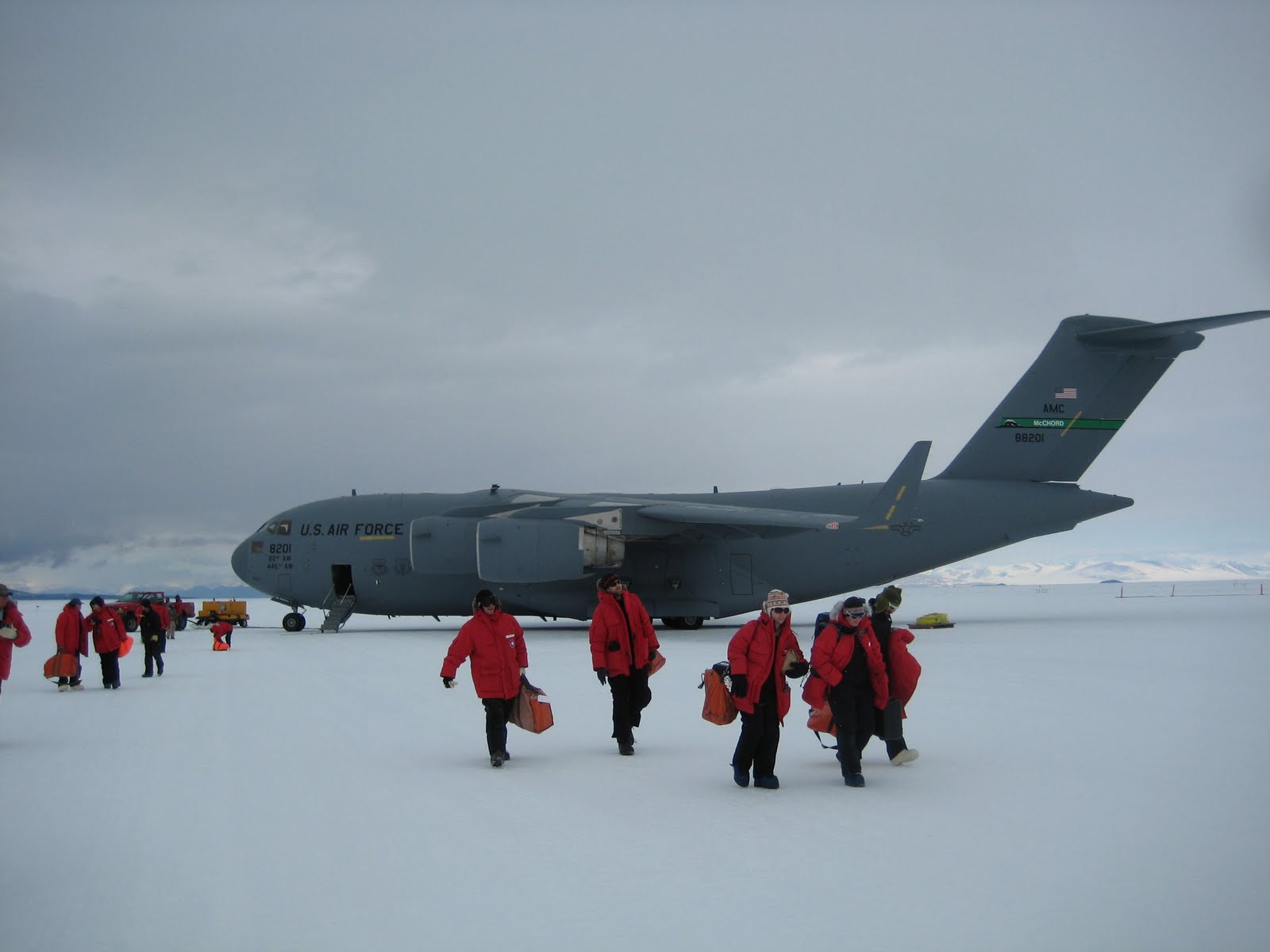
The flights that go from Christchurch to McMurdo are operated by the United States military, and those flights are very different from commercial flights.  Only people who have been approved by the USAP are allowed on those the airplanes traveling from Christchurch to McMurdo.  Some of the requirements to make it on the flight were to pass a physical exam (which I had back home during the summer) and a dental exam (which I also had back home in the summer) because they only want to send healthy people to such a remote place.  There are not very many doctors or dentists at McMurdo.  They also require everyone on the flight to have special extreme cold weather (ECW) gear.  The flight from Christchurch to McMurdo was on a C17 (a type of cargo jet).
  
Cargo inside the C17 cargo jet
Riding in a large cargo jet is a little different than riding in a regular commercial jet.  We sat along the side of the plane in fold-out seals.  We didn't really have windows or aisles.  And cargo that was being shipped to McMurdo was secured right in front of us, in the center of the plane.

The view from one of the few very tiny windows in the C17

A picture of the C17 jet on the ice at McMurdo
We landed on the Ross Ice Shelf near McMurdo, which is on Ross Island.

People walking on the ice from the C17 to Ivan the Terrabus
We then took a large orange bus with enormous wheels from the ice runway to McMurdo.  The bus ride was about 45 minutes.
People getting on Ivan the Terrabus
...and finally, around 12 pm on December 5 (New Zealand time) I was in McMurdo.

Monday, December 5, 2011

What to wear?

Many people ask what I wear when I'm working in Antarctica.  Luckily, the United States Antarctic Program (USAP) provides warm clothes for everyone who is traveling to the ice for the U.S.  Everyone headed to MCM has to stop at the CDC in CHC and check in with the USAP, where they are issued their ECW.  People use lots of acronyms down here... MCM is Mactown, or McMurdo Station.  The CDC is the clothing distribution center, which is located in Christchurch (CHC), a city in New Zealand.

ECW = Extreme Cold Weather gear
Bunny boots
Essential clothing items in Antarctica include the Extreme Cold Weather (ECW) gear.  My ECW includes a big red parka with my name on it... this jacket is appropriately called "Big Red."  ECW also includes hats, ski goggles, a balaclava, gloves, wind pants, and bunny boots.  Bunny boots are white rubber boots that are really warm, really big, and quite difficult to walk around in.  We are required to wear our ECW, or have it close at hand, whenever we traveling to/from Antarctica, or traveling around on the continent.  I also brought some of my own clothing, like my favorite wind-proof fleece and hiking boots, which are more comfortable, but not quite as warm.


My "Big Red" from 2010

Me (left) and Adam (right) in the Clothing Distribution Center in Christchurch , NZ at the beginning of the 2011-2012 field season

Hats and gloves provided by the USAP

Wind proof pants and long-underwear